
Purple is possible, but rare
| 10 October, 2017 | Sonja Ehlers |

|

|
Sonja Ehlers and Julius Ellrich, found the first purple-colored dogwhelks on the Atlantic coast of Nova Scotia, Canada. They describe their search for this rarity.

The dogwhelk Nucella lapillus is a common predatory snail from North Atlantic rocky intertidal habitats that consumes barnacles and mussels. The snail forages when submerged by water and hides inside its shell during low tides.
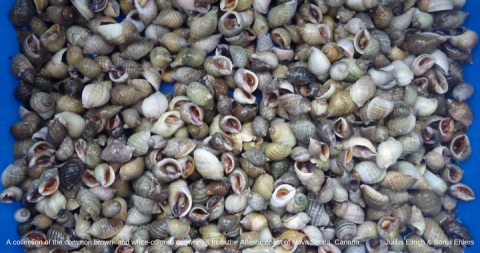
Shell color varies among dogwhelk individuals. Brown and white are common colors. As dogwhelks can easily be collected during low tides, marine ecologists have used them to study consumptive effects of predators on prey.
Predators, however, not only consume their prey, but also have nonconsumptive effects (NCEs) on it. In aquatic systems, predator NCEs are often mediated through waterborne chemical cues that are released by the predators and perceived by their prey. Such predator cues have been shown to trigger prey behavioral and morphological responses as, for example, prey moving away from the predator, or prey strengthening their morphological defense structures (e.g. through shell thickening or spine elongation), that reduce the risk of predation.
Predator NCEs on prey demographic responses, particularly in aquatic systems, have received comparatively little attention. Therefore, we chose to study predator NCEs on prey demography by using dogwhelks, barnacles and mussels as predator-prey model systems.
For our studies, we collected 6.000 dogwhelks from several locations along the Atlantic coast of Nova Scotia (Canada) between 2011 and 2016. We used them in manipulative field experiments that examined predator NCEs on recruitment of barnacles and mussels. All of these dogwhelks were of the common brown and white colors.
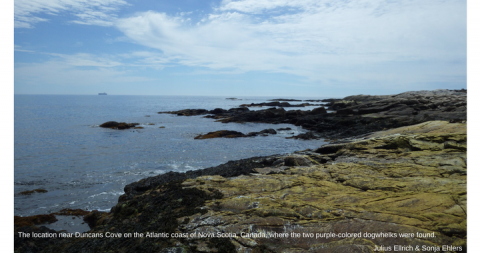
On 16 June 2016, we collected dogwhelks from a moderately wave-exposed coast near Duncans Cove (44°29’41.22”N, 63° 31’26.66”W) in the vicinity of Halifax. When searching the dense seaweed canopies and mussel patches along that coast for dogwhelks, we discovered two individuals of purple color. We were surprised, as we had not found any purple-colored dogwhelk on the Atlantic coast of Nova Scotia before. There was no information on dogwhelk shell color for that region, so we reported our rare finding.
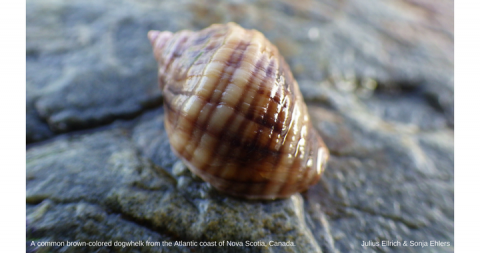
Purple-colored dogwhelks had previously been found on UK (Wales) and US (Maine, Massachusetts) coasts, where they have also been considered as rare. Darker-colored dogwhelks show stronger physiological responses to heat, such as faster desiccation, than lighter-colored conspecifics.
Field work from Massachusetts showed that purple-colored dogwhelks occur in wave-exposed habitats where splash by occasional waves, wet seaweed canopies and mussel patches cool and moisten such dogwhelks during low tide, thereby enabling their persistence. Our findings from Duncans Cove reinforce that notion, as they were made in a similar environment.
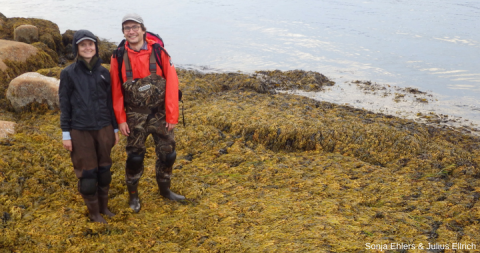
Since our discovery of the two purple-colored dogwhelks, we continued to search the coast for such snails during subsequent collections (2.000 dogwhelks in total) and regular field observations. However, we did not find any other purple-colored individual, showing that purple is a possible but rare shell color in dogwhelks from this region.
|
|
 previous post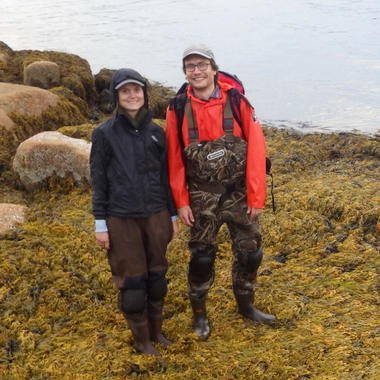


User comments must be in English, comprehensible and relevant to the post under discussion. We reserve the right to remove any comments that we consider to be inappropriate, offensive or otherwise in breach of the User Comment Terms and Conditions. Commenters must not use a comment for personal attacks.
Click here to post comment and indicate that you accept the Commenting Terms and Conditions.