Sex and horror: the surprising lives of nematodes.
| 8 August, 2014 | Samuel Winthrop |

|

|
The researcher stared at a writhing star-shaped mass of tentacle-like appendages, each with a mouth and teeth, and with a few of these severing themselves in half and carrying on individually …
Readers would be forgiven for assuming this was the sighting of a cosmic entity at the end of a Lovecraft novella, except the scientists in question are from Oxford, not Miskatonic University, and the phenomena form the findings of a recent paper in Current Biology, recommended to F1000Prime by Faculty Member Bob Goldstein, who aptly uses the words “weird”, “bizarre” and “completely unknown” to describe the article.
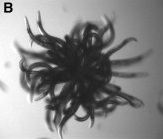
The entity itself is not from some God-forsaken antimatter galaxy, but is rather a group of the humble nematodes, found almost everywhere on the planet (although they have in actual fact been to space, but they are unlikely to have originated from there … [citation needed]).
Nematodes, or roundworms, are a diverse phylum of organisms, the most well-known of which, Caenorhabditis elegans, has been of great use to life science, advocated as a model organism for neuronal development by Sydney Brenner in 1963 and the first multicellular organism to have its whole genome sequenced.
Nematodes seem quite a simple organism, with a slender worm-like body around 2.5mm in length (although some parasitic species can reach over a metre!), but their simplistic appearance belies some strange behaviours, which have recently been the subject of two F1000Prime recommendations and an F1000Prime Report.
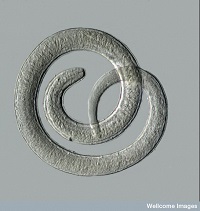
Nematodes of the genus Caenorhabditis are reproductively similar to most animals – with male and female versions of the species – but some, including the above mentioned C. elegans and another well-studied species Caenorhabditis briggsae, are hermaphrodites; more specifically, they are ‘androdioecious’: the species being made up of males and hermaphrodites.
[pullquote]… nematode mating systems are ideal for elucidating the origin of novel traits, and studying the influence of developmental processes on evolutionary change”. Ronald Ellis and Shin-Yi Lin[/pullquote]
The F1000Prime Report “The evolutionary origins and consequences of self-fertility in nematodes“, published this month and written by Ronald Ellis and Shin-Ye Lin of the Department of Molecular Biology, The State University of New Jersey, takes a look at how this reproductive and mating system evolved and developed, and how such a complicated physiological change occurred in terms of genetics and regulatory pathways. As well as being a fascinating example in which to study evolutionary biology, the authors note that “the task is simplified” by the existence of the genome sequences of these much-studied organisms.
Whilst on the subject of the unusual mating practices, the darker side of this arrangement was demonstrated in the PLoS One paper “Intense Sperm-Mediated Sexual Conflict Promotes Reproductive Isolation in Caenorhabditis Nematodes“, recommended to F1000Prime by Genomics & Genetics Faculty Member Norman Johnson.
Interspecies mating is possible in the Caenorhabditis genus – so what happens if a male from a species with no hermaphrodites (‘dioecious’) mates with a hermaphrodite from an androdioecious species? Again, evolutionary biology plays its role. Males from the dioecious species have the selective pressure of competing with other males’ sperm when mating; the onus is then on having the most ‘aggressive’ sperm to successfully fertilise the female. The androdioecious do not have the same selective pressures and thus the hermaphrodites are not used to such physiologically potent sperm. The findings of the paper demonstrated that the sperm is so potent that the poor hermaphrodite’s reproductive tract is actually damaged by it, with the sperm sometimes penetrating into other tissue, often rendering the worm sterile and shortening their lifespan.
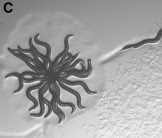
So what of our pulpy, tentacled horror? The “worm-star” phenomena is described by Hodgkin et al. in their chillingly titled paper “Two Leucobacter Strains Exert Complementary Virulence on Caenorhabditis Including Death by Worm-Star Formation“. The researchers observed the behaviour of worms from Cape Verde that had been infected by bacteria. On infecting clean C. elegans with one of the bacterial strains, the worms’ tails were fused together by the pathogen, creating a star-shaped body of trapped worms that would then perish, ostensibly a strategy that allows greater bacterial growth.
All was not lost, however, as the nematodes have a last ditch escape plan, involving ‘autotomy’ – the purposeful severing of an organism’s own body, and the first example of this in the entire nematode phylum.
As a parting note, I’ll leave you with this musing on just how ubiquitous these often terrifying little creatures are, from the turn of the century “father of nematology”, Nathan Cobb:
“… if all the matter in the universe except the nematodes were swept away, our world would still be dimly recognizable … we should find its mountains, hills, vales, rivers, lakes, and oceans represented by a film of nematodes. The location of towns would be decipherable, since for every massing of human beings there would be a corresponding massing of certain nematodes …”
|
|
 previous post